LovableRelational data, available to start today
Lovable is an established, polished tool with published pricing you can start using immediately. Its default PostgreSQL database is relational, making it a natural fit for software that relies on complex queries, joins and financial reporting. You also get ready-made payment integrations, social login, file storage and a large community sharing components. If you are building a browser-only SaaS that lives and dies on relational data, it is a proven choice.
appgntFull stack everywhere, code you own
appgnt provides a complete backend per app, provisioning its own accounts, document database, TypeScript server functions, work queues and secret store in an isolated cloud stack. That identical stack powers the web app, installable desktop software and native builds for Android and iOS. The output is a standard React and TypeScript project that you can edit directly, extend with npm packages or export as a zip at any time. You get one unified codebase across every platform, with full ownership and no lock-in.
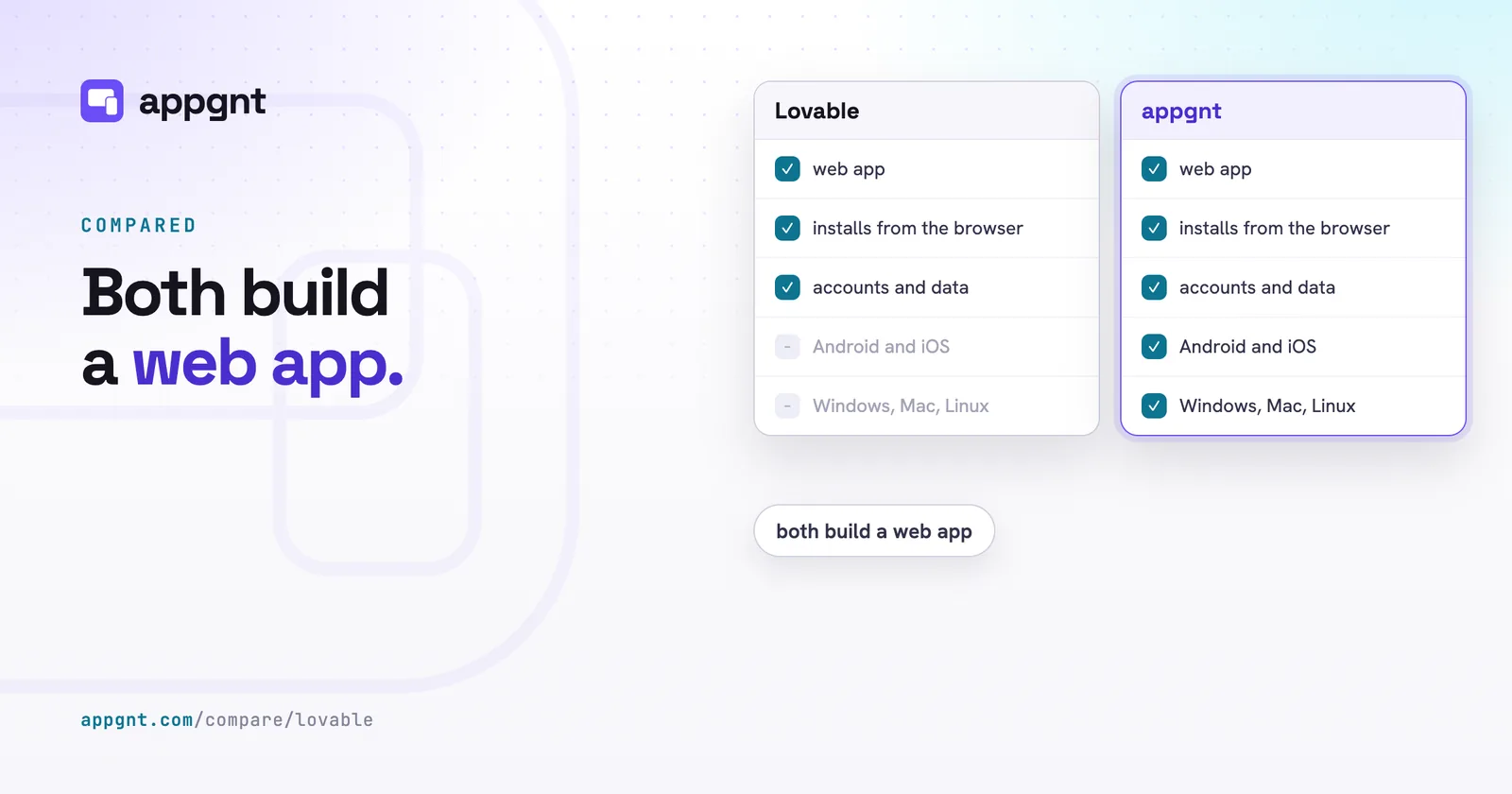
| Lovable | appgnt | |
|---|---|---|
| The web app | Yes, responsive web app deployed to a live URL | Yes, responsive web app deployed to a live URL and CDN |
| Accounts and sign-in | Email, password and social sign-in via Lovable Cloud or Supabase | Per-app Cognito user pool with email, password and verification |
| Database | Relational PostgreSQL via Lovable Cloud or Supabase | Per-app DynamoDB with scoped collections and read/write rules |
| Server code and background jobs | Edge functions in TypeScript | Per-function Node 22 Lambdas in TypeScript, run up to 60s |
| Work queues and scheduled jobs | Edge functions; no built-in queue documented | Dedicated SQS queue and dead-letter queue per task, plus cron |
| Where the data lives by default | In Lovable Cloud or your Supabase project from the start | On the device until the app asks for cloud storage |
| How the backend is isolated | Shared database infrastructure or your own Supabase project | Dedicated CloudFormation stack and IAM role per application |
| Installs from the browser | Runs in any modern browser | PWA installable from Chrome, Edge, Safari and mobile home screens |
| Your own domain | Supported on paid plans | Included; bare domain or subdomain with free automated SSL |
| Native Android and iOS | No native output; requires external wrapping or a developer | Generated Capacitor projects; exports APK, AAB and Xcode project |
| Desktop apps | Not supported | Generated Tauri 2 shells; exports Windows NSIS, Linux, macOS project |
| Extending the code yourself | Git sync on all plans; in-app Code Mode on paid plans | Standard React, Vite and npm; edit in studio or connect via MCP |
| Who owns the project and how you get it | You own the code; sync to GitHub, GitLab or Bitbucket | You own the code; download complete project zip at any time |
| Pricing | Monthly plans from US$25 plus usage-based hosting credits | Invite-only; no public price list yet |
| Maturity and availability | Established, large community, public sign-up and templates | Younger platform, invite-only waitlist, smaller community |
Both of them are full-stack app builders
The most common misunderstanding about these tools is that one builds frontends while the other builds backends. In reality, both give you a working full-stack web application from a prompt. Both write the user interface, generate the backend resources, handle sign-in, connect a live database, deploy the result to a public address, and let you attach your own domain.
Lovable builds on Lovable Cloud, powered by Supabase technology. Every project gets a relational PostgreSQL database, authentication with email and social sign-in options, file storage, and TypeScript edge functions for server-side logic. You describe what you need, and Lovable creates the tables, wires the authentication flows, and connects them to the user interface.
appgnt provisions a dedicated cloud stack for each application. When an app needs cloud storage, it receives its own Amazon Cognito user pool, an isolated DynamoDB database with custom read and write rules, Node 22 server functions written in TypeScript, background work queues with retries, and an encrypted store for API keys. Neither tool leaves you with a flat mockup. Both produce live software with persistent data and real server execution.
What appgnt does with that stack afterwards
The difference appears in where that finished software can run. A Lovable application is built exclusively for the web. If you want your customers to install it from Google Play or the App Store, you have to export the code, hire a developer, or configure a third-party wrapper yourself. Lovable's mobile application is an editor for prompting your projects from a phone, not a compiler that produces store binaries.
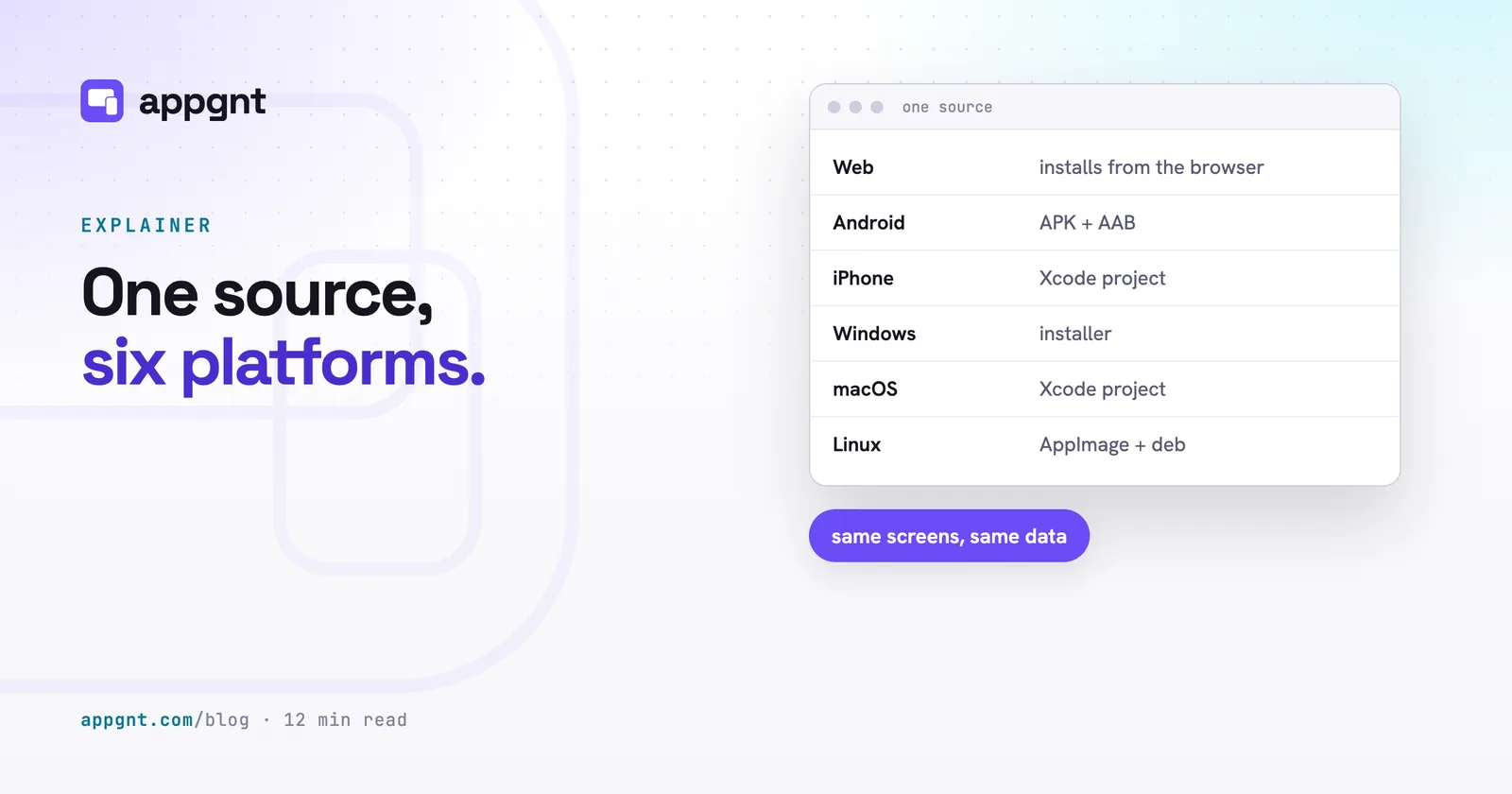
appgnt treats the web build as the primary foundation and simultaneously packages that exact code for mobile and desktop operating systems. The studio generates native Capacitor shells for Android and iOS, alongside Tauri 2 configurations for Windows, macOS and Linux. You can download an installable Android APK, a production App Bundle, or desktop installers directly from the Publish pane.
Because the app talks to its backend through a unified SDK over plain HTTPS, the client code runs identically inside a browser tab, a phone app or a desktop window. The client fetches its backend configuration at runtime. That means you can update server endpoints, collections or permissions in the cloud without forcing users to download an update from an app store.
Relational or isolated: two different bets on the database
Lovable and appgnt make fundamentally different technical choices about how data is structured and segregated. Lovable gives you a relational PostgreSQL database by default. PostgreSQL excels at complex SQL queries, multi-table joins, and structured reporting. If you are building a product like an accounting ledger, an inventory forecasting system, or an analytics dashboard where tabular relationships matter most, Lovable's relational foundation is well suited to the job.
appgnt uses a document store model backed by DynamoDB, combined with strict infrastructure isolation. Instead of placing your data in a shared multi-tenant database, appgnt builds a standalone CloudFormation stack for your app. Requests reach the database through an IAM role dedicated strictly to that application. Data isolation is enforced by cloud infrastructure policies rather than application code.
This architecture also handles local-first workflows gracefully. Many internal tools, such as site inspection checklists, field notes or warehouse counters, do not need cloud storage right away. appgnt apps keep data on the device using local browser storage until the app explicitly asks for cloud infrastructure. When you do turn on the backend, you get predictable read and write rules scoped per user or shared across the organisation, with support for document expiry and background queues.
Extending the app yourself
Both platforms give you access to real code, but they approach modifications differently. Lovable synchronises your project to GitHub, GitLab or Bitbucket repositories across all plans, and provides an in-app Code Mode on paid tiers. You can inspect changes, pull the code to your local machine, or let Lovable commit updates directly to your git history.
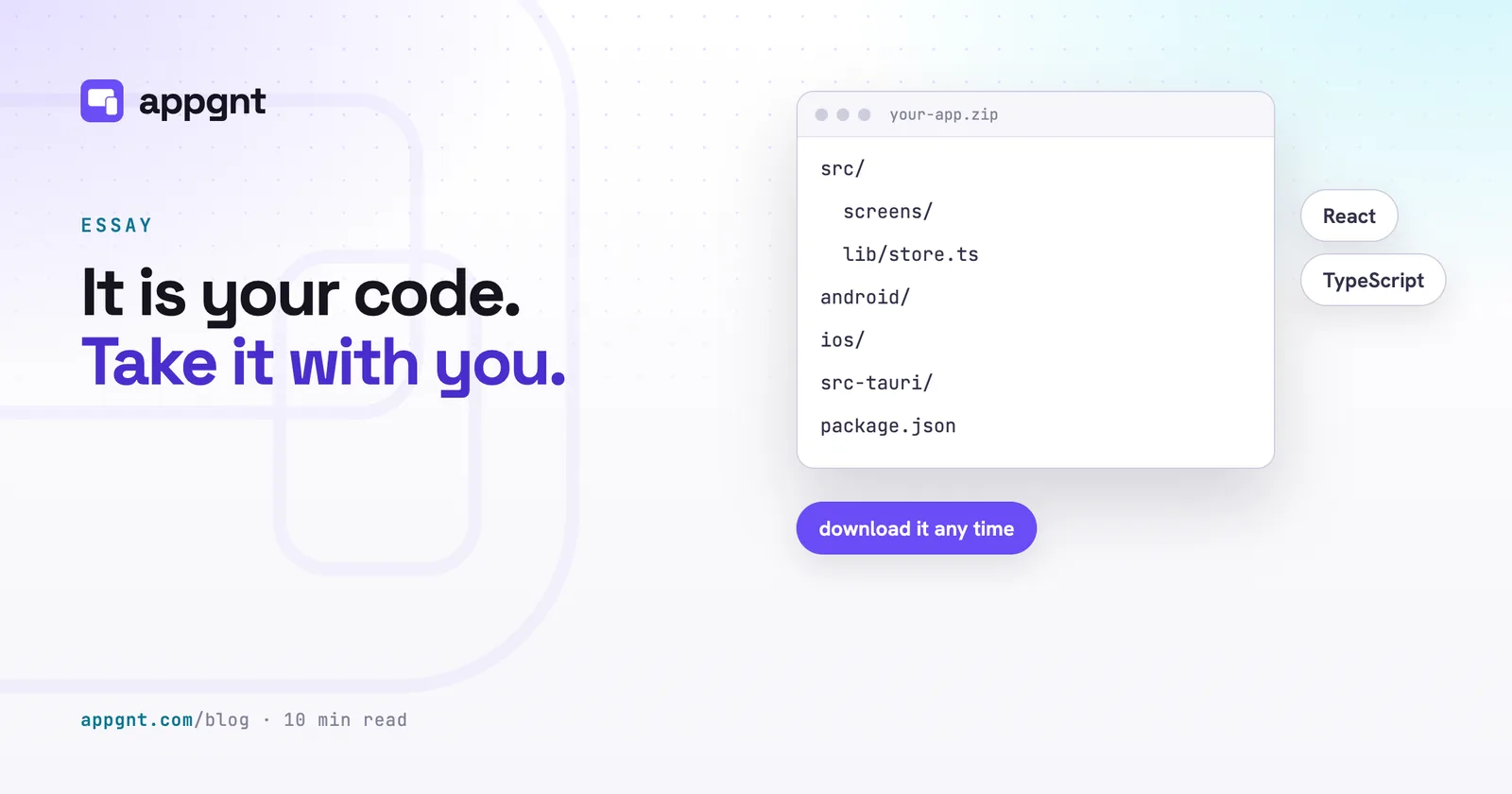
appgnt generates a standard React, TypeScript and Vite project. You can inspect and edit any file inside the studio's Files pane, install external npm packages, or write custom TypeScript server functions in a dedicated server folder. The project uses standard web and native conventions throughout, so any frontend developer can open the codebase and work on it without learning proprietary platform patterns.
You can also automate development outside the studio. appgnt runs an MCP server, allowing assistants like Claude Code, Cursor or Codex to inspect files, edit code, trigger builds and generate marketing assets directly against your account. If you ever decide to stop using appgnt, you can download the entire repository as a zip file. The React frontend, Capacitor mobile shells and Tauri desktop wrappers remain yours to host and maintain wherever you prefer.
Pricing, honestly
Lovable has published pricing based on build credits. A free tier offers five daily build credits to test the waters. Paid plans start at US$25 per month for 100 credits, with larger plans available for teams needing single sign-on and shared workspaces. Every prompt consumes credits depending on the complexity of the change, and credits expire after two months. Lovable Cloud hosting is billed separately based on resource consumption.
appgnt does not have a public price list yet and operates on an invite-only waitlist. If you need a tool you can sign up for and expense on a company credit card this afternoon, appgnt cannot offer that today. You have to request access and wait for an invite.
Whichever tool you choose, publishing to official app stores introduces fixed external costs that neither platform covers. Google charges a one-off fee of US$25 for a Play Console account. Apple charges US$99 every year for membership in the Apple Developer Program. Building iOS and macOS binaries also requires access to a Mac running Xcode to sign and package the final app.
Which should you choose?
If your priority is launching a browser-based SaaS product today, Lovable is the more practical option. It is a mature platform with an active user base, immediate self-serve onboarding, ready payment integrations, and a relational database that handles reporting and billing structures straight out of the box.
If you need a single full-stack application that works identically in a browser, installs on a phone, and runs on a desktop computer, appgnt is built specifically for that purpose. It provisions dedicated cloud infrastructure for each project, allows deep code customisation with normal developer tools, and exports store-ready packages from one source.
Pick Lovable if:
- You are building a web-only SaaS and do not need native mobile or desktop builds.
- Your data model depends on relational tables, complex joins and SQL queries.
- You want to start building right now at transparent, self-serve credit tiers.
- You want ready-made integrations for customer subscriptions and social logins.
Pick appgnt if:
- You need one full-stack app that runs on the web, Android, iOS, Windows, macOS and Linux.
- You want dedicated cloud infrastructure with an isolated user pool and database per app.
- You want to extend the code with standard npm libraries, TypeScript Lambdas and MCP tools.
- You prefer local-first data storage for offline workflows until cloud sync is required.
Questions people ask when choosing
Does appgnt build web apps too, or only mobile apps?
Yes, appgnt builds a complete web app first. Every message creates and tests a responsive React web application, which deploys to a CDN with an instant address. You can run it in any modern browser, map it to your own custom domain, or install it directly to your home screen or desktop as a progressive web app.
Does an appgnt app get a real backend with accounts and a database?
Yes. When an app needs cloud services, appgnt provisions an isolated Amazon Web Services stack containing a Cognito user pool for accounts, a DynamoDB database with custom security rules, Node 22 TypeScript server functions, work queues and a secret store. All resources are isolated by cloud IAM roles so apps never share infrastructure.
Can Lovable make native mobile apps?
No. Lovable is exclusively a web development platform and does not compile native iOS or Android binaries. Its mobile app is an interface for managing and prompting your projects from a phone. To put a Lovable project into app stores, you must export the code and use third-party packaging tools or hire an engineer.
Can I extend an appgnt app with my own code?
Yes. An appgnt project is standard React, TypeScript and Vite. You can browse and edit files directly in the studio, add dependencies using npm, write custom backend Lambdas in TypeScript, or connect developer assistants through the MCP server. You can also export the full source code as a zip file at any point.
Which has the better database?
They serve different needs. Lovable provides relational PostgreSQL, which is ideal for complex relationships, joins and heavy reporting. appgnt provides a per-app DynamoDB document database, which is designed for scale, predictable single-record lookups, granular access rules and strict infrastructure-level isolation between applications.
Is appgnt cheaper than Lovable?
It is difficult to compare directly because appgnt is currently invite-only and does not publish public pricing tiers. Lovable charges via monthly credit subscriptions starting at US$25 per month, plus separate usage fees for backend hosting. If you need immediate, predictable self-service pricing today, Lovable has the advantage.
Which is better for a public SaaS?
If your SaaS is purely web-based, requires user subscriptions via Stripe, and relies on relational data queries, Lovable is more mature for that workflow today. If your SaaS requires users to install native apps on mobile or desktop devices while keeping each customer's data isolated within dedicated cloud stacks, appgnt is the better architecture.